Sunday, 30 September 2012

'Angel Heart': Only a few more days before publication!

A mysterious Templar relic.
A web of intrigue and lies.
A woman about to lose her heart.

I am delighted to announce that ‘Angel Heart’ will be published on Friday 19th October 2012 by MuseItUp Publishing.

Blurb

Devonshire, January 1815.

Marie-Ange, the young widow of an English officer, accepts an inheritance in France only to find that everything in Beauregard is not as it seems. Why is the sinister Malleval so obsessed with her family? And could her darling Christopher still be alive? Marie-Ange finds herself trapped in a dangerous web of lies, intrigue, and mystical possession, and the only person to whom she can turn for help is Capitaine Hugo Saintclair. Yet the enigmatic Hugo represents a danger of a different kind …

Angel Heart is a lavish mix of romance, adventure, and a hint of the supernatural, largely set in France against the turbulent background of Napoleon’s return from Elba.

Here is a mini-excerpt from the beginning of the book.

The cutter was sailing too close to the cliffs, heading straight for the Devil's Tooth. Marie-Ange's cloak billowed in the blustery wind, the hood blew back and her hair swirled like a golden veil around her. From the cliff top, she watched the small French ship dancing wildly on the waves, its tricolour and white ensigns flapping at the top of the mast.  If it carried on its course the ship would be ripped open by the reef… She unfastened her cloak, pulled her black shawl from her shoulders, and waved it above her head in the direction of the Devil's Tooth.

Damn this ship. Damn this weather. And damn Malleval. Hugo Saintclair clapped his hands together a few times and blew on them to keep them warm. Around him, the crew shouted orders and heaved on ropes in order to switch sails and change course before they hit the rocks.  The Angel warned them, the sailors said, heaven was on their side. Shaking his head with impatience, he listened to their nonsensical chatter. Angels didn't exist, but the woman who waved at them from the cliff top had saved them from a certain death.

‘Angel Heart’ is available to pre-order at a special 20% discount. Just click here!

Friday, 14 September 2012

Maybe Too Good to be True...

Today I am delighted to welcome author Christy McKee on my blog. Christy has just published her contemporary romance "Maybe Too Good to be True" with MuseItUp Publishing.


Hello, Marie,
Thank you for having me as your guest this week. As you know, the prospect of having your first novel published is exhilarating and a little scary.

What’s In a Name?
Deciding on my pen name, McKee wasn’t a random selection based on sound, curb appeal or location on a bookstore shelf. I chose McKee because my father named me after his grandmother, Christina Ann McKee. Although I never had the privilege to know my great-grandmother, stories of her courage, strength, and compassion have always been a part of my life.
When my great grandmother McKee was a young woman she barely survived two years of peril in the dust bowl in Kansas.

Defeated by crop failure resulting from drought and devastating dust storms, she took charge of her aging parents and her siblings and led their retreat back to Ohio where she started a modest chicken hatchery which eventually grew into a successful commercial operation that provided her family with a comfortable life. My father’s own mother died when he was six years old. His grandmother McKee took him in and raised him in a loving, nurturing home until adulthood. She instilled in him the belief that he could accomplish anything with devotion and perseverance.  
In choosing the name of McKee, I am honoring the woman I never met but who lived for me in my father’s tales of her kindness, love and— when necessary— grit.

When and Why Did You Become a Writer?

My career began—not as a writer— but in TV news, working as a reporter and news anchor in Missouri and later in Ohio. The only reading I did was off the teleprompter on set. When I married, I would follow my husband from Detroit to Baton Rouge with stops in between in Georgia, South Carolina, Kentucky and Ohio. I had to reinvent myself to find a job in each “new” town.  From real estate sales to advertising, to co-producer of a southern university’s Writer’s Workshop series featuring John Irving and Kurt Vonnegut, my career path was full of twists and unexpected turns. 

Even though my voracious desire to read began in my childhood during a bout of the measles, I didn’t try my hand at writing until a few decades later. After “getting some age on me,” I began to write a contemporary romance. It was like the stars aligned and my life clicked. I knew I was doing what I was meant to do.  With my husband’s support, I quit my day job, came out of the closet and announced I was a full time fiction writer.

After four incarnations and a year under the bed, my first novel Maybe Too Good to Be True is releasing this summer. Today, I live in rural, picturesque Ohio with my family and two Labs.  Lambeau is the unofficial dog of the Green Bay Packers and Gracie is well, just sweet Gracie.  

Blurb

Gabrielle March is summoned to an oceanfront estate in Massachusetts by the matriarch of Atlantic-Hastings International where she is presented with a hefty block of shares as amends for a crime committed against her family. The stock—worth several million dollars—can give her the means to make her dream come true if only she can muster the courage to break free from her past and believe in her unique creative talent.    
Pierce Hastings, son of Gabrielle’s benefactress, grudgingly agrees to take her under his wing and acclimate her to Atlantic-Hastings.  Never one to mix business with pleasure, Pierce stuns himself when he ignores his own self imposed rule. Gabrielle’s complete lack of artifice, unvarnished honesty and quirky sense of humor are intoxicating to him―and he’s rapidly becoming addicted. He’s blindsided when Gabrielle confesses that, in spite of her growing feelings for him, she will never fit into his world of power and privilege. 
           

Excerpt, Pool Scene
“The fact is, Mr. Hastings, it is not a reporter’s job to be favorable. They are in the business of finding and reporting the truth.”
            "Nobly put, Miss March.” The woman certainly didn’t pull any punches.
            “I hope this will put you at ease, Mr. Hastings. I own the newspaper. It’s been several years since I single-handedly set out to ruin anyone.”
            Sarcasm, even with a lovely Southern accent, was still sarcasm.
            "I see.” Pierce sounded duly impressed. “That’s certainly an accomplishment for such a young …” He froze when her eyes narrowed. What the hell was wrong with him? He careened from one blunder to the next.
            "Tell me, is it my age or the fact that I’m a woman that bothers you?” Her face was considerably more colorful than the rest of her and he knew it had nothing to do with the heat.
             Pierce was no chauvinist and certainly had no prejudice against successful females. After all, he’d been married to a talented trial attorney. Hadn’t he put his wife through law school? Hadn’t he supported Glenna in every way until she made partner in her firm and then announced that she’d changed her mind about having children and, by the way, she didn’t want to be his wife anymore either.
            "I didn't mean that you weren't responsible.” His eyes returned to the very entertaining Miss March who had just snapped up the ball and was ready to run with it.
            "What would someone like you know about responsibility anyway? You've probably never put in an honest day’s work in your entire over-privileged life. Flying around the world trying to stay one step ahead of reality. One of these days you’re going to have to come down to earth and see what it’s like in the real world.”
             Where did the woman get her information? She’d obviously pegged him as some sort of wealthy derelict. Fired up, she was something. Misinformed maybe, but she had balls of steel. "For a newspaper woman, you’re lacking in your facts, Miss...."

                        You can reach me here:
            http://christymckeewriter.blogspot
            http://twitter.com/ChristyMcKee


Christy is giving away a free copy of her ebook at the end of this weekend. Plus,  your name will go into the drawing to win a $30 Amazon gift card on September 29. To qualify for both giveaways, you must leave a meaningful comment or question and include your email address.


Thank you Christy for being my guest today!

Friday, 3 August 2012

Cover for 'Angel Heart'

I just wanted to share the cover for 'Angel Heart', my historical romance to be published by Muse It Up Publishing in September 2012. I am delighted with it!


Here is an outline of the story:

Marie-Ange, the young widow of an English officer, accepts an inheritance in France only to find that everything in Beauregard is not as it seems. Why is the sinister Malleval so obsessed with her family? And could her darling Christopher still be alive? Marie-Ange finds herself trapped in a dangerous web of lies, intrigue and mystical possession, and the only person to whom she can turn for help is Captain Hugo Saintclair. Yet the enigmatic Hugo represents a danger of a different kind …

‘Angel Heart’ is a lavish mix of romance, adventure and a hint of the supernatural, largely set in France against the turbulent background of Napoleon’s return from Elba.

Having the cover now makes it all real!

Saturday, 21 July 2012

Logic, Poetry and Revolution


I know I’m a week late...

Bastille Day was last Saturday but I wanted to write about some of the things I absolutely love about the French Revolution. Not the guillotine and the years of Terror, the burning of chateaux, massacres and terrible abuses of power, of course. I just love the revolutionaries’ enthusiasm for change, their thirst for reform and their sometimes completely crazy ideas.

Take the calendar which came into effect in 1792 and remained in place until Napoleon abolished it in 1806.

It wasn’t enough to make a break with the old Gregorian calendar and its references to the birth of Jesus Christ and to turn 1792 into the Year 1 (An I) of the new era. In the republican calendar, months and days were renamed and rearranged in a more ‘logical’ manner so that there were twelve months which were each divided into three exact periods of ten days.

Forget the old lundi (Monday), mardi (Tuesday) and so on… The new days were called primidi, duodi, tridi, quartidi, quintidi, sextidi, septidi, octidi, nonidi and decadi! Decadi was the day of rest. However, many people protested that they were losing out under the new regime since they only had a day of rest in ten days whereas before there was a Sunday every seven days!

The new republican year didn’t start on January 1st but at the time of the autumn equinox, around 22nd September.


To make the break with the ‘Ancien Régime’ even more drastic and erase any mention of Catholic saints and festivals, each day was placed under the sign of a plant, an animal or an agricultural implement. Some days sound wonderfully poetic (Reseda, olive, pistachio, basil, peach), others very down to earth (water can, manure, shovel) and others just a little weird (salt, lead, zinc, pig, donkey!).


The poet Fabre d’Eglantine was given the task to find new names for the months which would evoke the power and the beauty of nature. I must say I think he did a good job.

For autumn, he chose Vendémiaire (from the word 'vendanges' which means grape picking), Brumaire (mist) and Frimaire (wintry weather). In winter, we had Nivôse (snow), Pluviôse (rain) and Ventôse (wind). The spring months were Germinal (germination), Floréal (flowers) and Prairial (meadows). Finally Fabre d’Eglantine named the summer months Messidor (from the summer 'moissons' or harvests), Thermidor (heat) and Fructidor (fruit).


As there were five days left at the end of the year (from 16th to 22nd September) Fabre d’Eglantine decided there would be celebrations of republican values such as Virtue, Engineering and Work. A most peculiar celebration was the ‘Fête de l’Opinion’ during which French people were allowed to make fun of civil servants and public figures any way they liked – be it caricatures, songs or pamphlets. According to Fabre d’Eglantine, the ‘Fête de l’Opinion’ would make sure there could be no abuse of power from the men in charge of public affairs. Was he a little naive? Poor Fabre d'Eglantine was guillotined on 17th Germinal, Year II (6 April 1794). I wonder if it was because the civil servants didn’t like his idea of the ‘Fête de l’Opinion’!

But that’s not all!


Obsessed with mathematical rigour and scientific reasoning, the revolutionaries also decided to change the way time was measured and divide the day into 10 hours, themselves divided into 10 parts, each one divided in a further 10 measures! The new time system didn’t however go down very well and confused people too much. It was abolished in 1795 (Year III). 

Saturday, 23 June 2012

The perfumes of an imperial couple

Still on the topic of fragrances…
The perfumes of an imperial couple

I have just finished reading the letters Napoleon wrote to Josephine when they were lovers after they met in 1795 and before their marriage in March 1796. He wrote to her constantly whilst on campaign, long, passionate letters, testimony to his love and obsession for her.

‘I awake full of you. Your image and the memory of last night’s intoxicating pleasures left no rest to my senses.’

‘Without your love, there’s nothing left for me on this earth and I’ll have to die.’

And  ‘There wasn’t a day when I didn’t love you, a night when I didn’t think of holding you in my arms. I curse glory and ambition for keeping me away from the woman who is the soul of my life. As I carry on with my work, head the troops, inspect the camp, my adorable Josephine is the only one in my heart.’


Along with these burning declarations of love, he sent her precious gifts from Italy, where he was fighting the Piedmont’s and Austrian armies, among which perfumes and colognes. It was indeed in Italy that ‘eau de cologne’ was invented.

Napoléon Bonaparte and Joséphine were both very fond of colognes and perfumes, so fond that before his coronation in December 1802, Napoleon asked perfume maker François Rancé to create perfumes for himself and Josephine. He gave Rancé specific instructions. His own perfume should not overpower Josephine’s but when the couple were together their scents should merge into a harmonious and unique scent. Rancé created ‘Le Vainqueur’ (the Victor) and ‘L’Impératrice’ (the Empress), which by the way you can still find today. ‘L’Impératrice’ has since been renamed ‘Joséphine’.

It wasn’t the first time that Rancé, a fervent admirer of Napoleon Bonaparte, created a fragrance in his honour. He had already dedicated ‘L’Eau d’Austerliz’ and ‘La Gloire à l’Aigle Français’ (Napoleon liked to be compared to a majestic, powerful eagle) to him.

Napoleon also liked eau de cologne. His favourite cologne was a very light blend of citrus fruit, ‘Eau de Cologne’ by Houbigant. He loved it so much he used up to 60 bottles every month, pouring it into his very hot baths and rubbing it into his skin.

However, during his exile at Longwood House on the island of St Helena, he couldn’t get his beloved cologne any longer. His servant, Louis-Etienne Saint-Denis - aka ‘Ali le Mamolouk’ worked very hard to try and recreate it for him. He wrote down the composition of the cologne and his ‘recipe’ based on lemon, bergamot, rosemary and citron essences, was found in family papers in 1990.


This cologne called ‘Napoleon 1er à Sainte-Hélène’ is available from a French perfume house. So if you want to experience what the emperor smelled like, you can!

Joséphine loved perfumes too. A native of the Martinique in the West Indies she had a predilection for exotic scents such as vanilla, cinnamon and clove, but her all time favourites were musk, violet and rose. She grew more than 250 varieties of roses in the garden at her Malmaison estate near Paris and created several new varieties including ‘La Malmaison’, ‘l’Aimable Rouge’ and, of course, ‘Joséphine.’


As well as indulging in baths perfumed with Houbigant’s floral cologne ‘Quelques Fleurs’ , she was passionate about musk. She wore so much musk she started a fashion for it and was even nicknamed ‘La Folle du musc’.  Her bathtub at the Tuileries palace is said to have retained the scent, almost 200 years after her death. In December 1809, after Napoleon told her he was divorcing her because she had failed to produce an heir, it is said that she poured great quantities of musk all over the imperial apartments so that he would never forget her and Marie-Louise of Austria, his new wife, would feel always ‘smell’ her presence.

She needn’t have bothered. Napoleon never forgot her, never ceased to love her. The last words he said before dying at Saint-Helena were ‘France, the army, the Head of the Army, Josephine.’


Sunday, 3 June 2012

Little time bubbles...

As writers we know how important it is to use the five senses - sight, smell, taste, touch and sound - to bring scenes and characters to life and immerse the reader in the story.

The sense of smell is, I think, the most magical, powerful and nostalgic of all senses. A fleeting, ephemeral scent can make us travel back in time and bring people and emotions back to life - if only for a few seconds. It can make us smile or cry, it can be soothing or reopen old wounds.

There are scents many of us can identify and relate to. A writer uses scents to give the reader a better, more intense feel for a particular place, time or scene. Some smells may be a little 'cliché' but still work: the smell of burning leaves which reminds us of autumn; clementine and orange peel, cinamon and clove take us back to winter and Christmas whereas freshly-cut grass evokes spring and summer. As for flowers and plants, many readers will know the scent of roses, lilac, wisteria, lilies, to name but a few. A scene describing a walk in the countryside will feel more real if it includes scents, for example woods carpeted with wild garlic and bluebells or with damp, rotten leaves; a deep forest of fir trees with pine needles on the ground; the scent of grass and earth after a spring shower...

To help make characters unique and bring them to life we often give them a unique fragrance. As I mainly write historical romances I do confess to a predilection for certain fragrances such as sandalwood shaving soap for my hero (I do love the warmth and spice of sandalwood), and vanilla, rose, jasmine or orange blossom for the heroin. Other distinctive scents can also help define a character, for example tobacco, cigarette and cigar smoke which cling to their clothes, or the smell of brandy, whisky or mint pastilles which lingers on their breath. And let's not forget leather...

Both the reader and the writer call on their own experiences to remember the scents described or mentioned in a story. And where the reader has no experience of a particular scent he or she will have to resort to imagination. After all, vegetation, climate, animals, seasons and festivals, foods and drinks vary greatly across the continents. When writing 'The Lion's Embrace' which is mostly based in North Africa, where I've never been, I had on a few occasions to use my imagination to describe what certain dishes, flowers or animals smelled like if I couldn't find out myself (like a trip to Chester zoo for lions and  camels!) or from any other reliable source.

Perfumes can be associated with happy, traumatic or painful memories and the emotions some trigger are so personal they can be difficult to capture and communicate. To this day I cannot be near a woman wearing Guerlain's Shalimar without feeling my heart breaking. It was my mother's favourite perfume.  Ysatis of Givenchy will always remind me of the year I spent in Paris, or should I say of the year I wasted in Paris, trying to pretend I was someone I wasn't - so no great memories there at all. Food smells are incredibly evocative too. Tomato and garlic sauce, couscous, jam and freshly baked fruit tarts, especially apricots (we had an apricot tree in the garden), will aways remind me of home. If I close my eyes, I can almost hear my mother - my wonderful, funny and loving mother - sing off-key in the kitchen.

So fragrances can be like little time bubbles or time machines allowing us to revisit places and moments in time, whether we want it or not. 

One day last week, I travelled back in time - a combination of smells and fragrances took me right back to Lyon, my home town, and to one particular sunny June morning, a long time ago.  


It's early - well before nine o'clock - but warm already. The terraces are busy, cafés doors are open and let out a riot of smells - coffee, beer, lemonade, mint cordial, Pernod, beer and wine (yes, even at that time of the morning!) as well as sounds of waiters calling orders, crookery and cutlery clincking, expresso machines and music. Every time I walk past a bakery I breathe in the scents of bread, croissants and brioches and fantasize about breaking off the end of a warm, freshly-baked baguette and biting into it.    
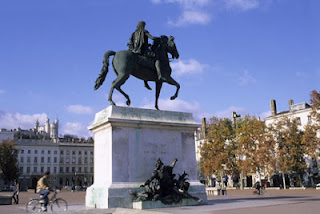


The red sand on Place Bellecour must have just been raked because there's dust in the air and it makes me sneeze. The pavements and gutters have been sprayed clean with water, they're still wet under the lime trees along the square. I don't want to get my pumps wet so I jump over the puddles.

I smell the river - silt, green waters and weeds - before I can see it. A few more steps to the end of the street and the Saône is in front of me, wide and fast. Bright sunlight shimmers on the surface, a light breeze blows from the South along the quays. I take a deep breath and smile, thinking of the seaside where you said we might go, soon.


There's a small market on the embankment. I slow down in front of crates piled high with sweet, fragrant white and yellow peaches, ripe Cantaloupe melons, and big, lumpy, juicy tomatoes. Rows of fluffy green lettuces, still damp with dew and with soil clinging to their roots, give out a strong, earthy smell. Traders call out prices, promise passers-by a taste of heaven on earth for a few Francs (this is long before the Euro). I smile and shake my head. I'm not buying anything just yet. Maybe later...

I cross the footbridge to the old district, turn into a narrow alleyway. The doors of Cathédrale Saint Jean are wide open. Warm, smoky scents of wax candles and incense spill out onto the square together with shadows and silence. I spare a few glances for the second-hand shops and their boxes of musty old books, yellowed maps and faded sepia postcards on the cobbles.

Finally, I arrive at the terrace of the café where you’re waiting. You must have been here a while. Your black leather jacket hangs at the back of your chair. The cup of expresso in front of you is empty. You look up, close your book, put your cigarette out. And you smile. As always it makes the sun brighter, the sky more blue, the day more beautiful. I bend down to kiss you and breathe in the unique scents which are you... which were you.

One sunny morning, a long time ago, captured in a little time bubble...  

What's in your time bubble?


Monday, 28 May 2012

A day on my own just to write... What could possibly go wrong?

I was so looking forward to today.


The sky was a pure blue, flowers were everywhere, spots of colours in the sunshine, birds were singing and a light breeze was coming through the open window of my makeshift study.

And more importantly, it was going to be one of those rare days when I would be alone in the house, with nobody to distract me and nothing else to do than get on with my story. I had a plan, I was bursting with ideas, I had images and bits of dialogues in my head. It was going to be a wonderful and productive day. I couldn't wait to write.

Things started to go wrong when child number one came back early from college - lessons cancelled - and embarked on playing his guitar, watching TV, playing noisy computer games and demanding lunch ... I gritted my teeth, closed the door and stayed focussed as long as I could. However feelings of motherly guilt for ignoring my first-born for the sake of imaginary characters and romantic plots pushed me out of the study and I got side-tracked.

When I came back to the computer I made the mistake of checking my emails, which in turn led to going onto the internet and reading a few blogs I follow.... Before I knew it, it was time to walk up to school to pick up child number three. Never mind, I still had an hour before child number two came back from high school and started demanding food and attention. I was just getting back into my story when the phone rang. One think I can't do is let the phone ring, and then I'm not very good at telling people I'll call them back because now isn't a good time to chat. So by the time I put the phone down, well... not only children one, two and three were reminding me it was time to make their tea but the writing mood was completely lost.

It's now a beautiful evening, the birds are still singing, and there isn't a single cloud in the sky...